Item 001 · Hostinger Website Builder
The price is $2.99. The price is also $10.99.
Month 49the renewal cliff
3.68× the intro rate · every month after
One coin ≈ $1 a month
Keep this till month 49
PennySite covers one product: the Hostinger website builder. Every figure on this site is printed with the figure it becomes at renewal, because an introductory rate on its own is not a price — it is an offer with an expiry date.
Price ladder · 48-month term
USD · 20 Sep 2026
Premium$2.99/mo
Renews at $10.99/mo — 3.68× the intro rate$143.52 charged upfront for the full term. Up to 3 sites · 2 mailboxes · 5 AI credits.Unlimited$3.99/mo
Renews at $16.99/mo — 4.26× the intro rate$191.52 charged upfront for the full term. Unlimited sites · store features · 15 AI credits.Cloud Startup$7.99/mo
Renews at $25.99/mo — 3.25× the intro rate$383.52 charged upfront for the full term. Everything in Unlimited · 20 agent credits.Intro rates require the 48-month term and are billed as one payment. Month-to-month is $11.99–$27.99. Renewal prices are the ones that repeat.
One product, one desk
Most site-builder coverage is a league table. This is not one. PennySite examines a single product in detail — the Hostinger Website Builder review is the centre of the site, and everything else on the roll supports it. The reason for the narrow focus is simple: the interesting questions about this builder are arithmetic ones, and arithmetic needs room. What does a plan cost across a full term? What happens in month forty-nine? What does an AI credit actually buy, and what happens when the credits run out? Those answers do not fit in a row of a comparison grid.
The house rule
No introductory price appears on this site without its renewal price attached. Not in a heading, not in a table cell, not in a passing aside. The discount on the Premium plan is 75 percent, which is genuinely large, and it applies to exactly one term. After that the account moves to the standard rate and stays there for as long as you keep the site. A review that quotes the first number and shrugs at the second is describing a sale, not a product.
Intro rate, first termRenewal rate, every month after
Premium$2.99 → $10.99 a month
Unlimited$3.99 → $16.99 a month
Cloud Startup$7.99 → $25.99 a month
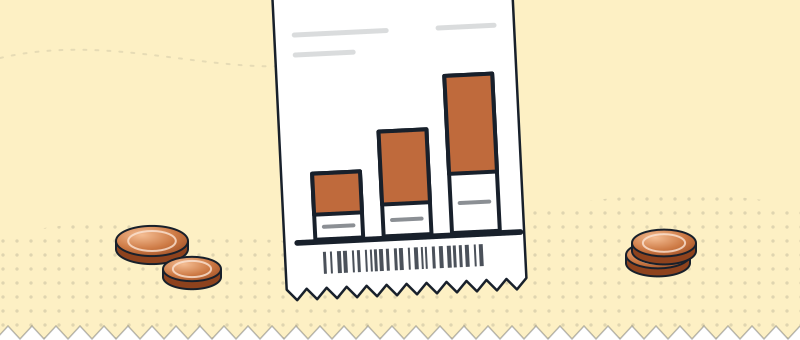
Same scale on all three. The line jumps where the prepaid term ends — month 49 — and, at today's renewal rates, stays there.
The second rule is that a monthly figure means nothing without the term that unlocks it. The cheapest rate on every plan requires a forty-eight-month commitment paid in one charge. That is a legitimate way to buy hosting and many people should take it. It is not, however, three dollars a month in the sense most readers hear it. It is one hundred and forty-three dollars and fifty-two cents today, and a different, larger number four years from now.
What is on the roll
The full review scores the product and explains the score. The plans and renewal page lays out every plan against every term length so you can see which combinations are worth taking and which are traps. The fit guide is the page to read if you already know the numbers and want a straight answer about whether this is the right tool for what you are building. The line items below go deeper on individual charges: credits, the store, the SEO panel, and the export path out.
Where the numbers come from
Prices are read off Hostinger's own public pages in US dollars and dated on every page that quotes them. Where the vendor's claim and an independent count disagree — the template library is the clearest example — both numbers are printed and attributed, rather than the friendlier one being chosen. Where a figure could not be confirmed on the day of checking, the copy says so in plain words instead of rounding it into confidence. Promotional rates move often, and regional pricing differs, so treat every figure here as a dated snapshot rather than a quote.
PennySite earns a commission if you buy through a link here. That pays for the desk and changes nothing above it. There is no arrangement under which a score moves, and the least flattering figure on this site — the renewal multiple — is the one printed largest.
Line items
All entries
Hostinger's Free Domain and Mailboxes: What Year Two Costs
The domain and the email that come with your plan are free for twelve months, not for the term. On a four-year plan that means a price rise in month thirteen, three years before the one anybody warned you about.
Hostinger's AI Builder Has Two Modes. Here's Which One to Use
Hostinger folded Horizons into the website builder, so one subscription now buys a drag-and-drop editor and a chat-driven generator. They are good at different things, and only one of them spends credits.
Hostinger Horizons Review: The AI App Builder, Now Included
Horizons is no longer a separate subscription — it is the agentic mode of Hostinger's builder. That makes it better value and raises a harder question about what fifteen credits can realistically produce.
Hostinger AI Credits: What 5 Credits Actually Buys You
The credits bundled with a Hostinger plan are a one-time gift, not a monthly allowance. Five of them on Premium is roughly one simple site, and then you are buying top-ups.